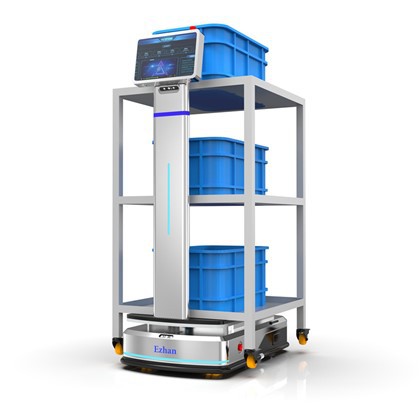
The battery life of an Automated Guided Vehicle (AGV) is a critical factor that significantly impacts its performance and operational efficiency. As an AGV supplier, we often receive inquiries from potential customers about how long the battery life of an AGV can last. In this blog, I will delve into the various aspects that influence the battery life of an AGV and provide some insights based on our experience in the industry. AGV
Factors Affecting AGV Battery Life
Battery Type
- Lead – Acid Batteries: These are one of the oldest and most commonly used battery types in AGVs. They are relatively inexpensive and can provide a high amount of current. However, their energy density is lower compared to some other battery types. Lead – acid batteries typically require regular maintenance, such as checking the water level in flooded lead – acid batteries. The lifespan of a lead – acid battery in an AGV can range from 2 to 5 years, depending on usage and maintenance. Their charge – discharge cycles are usually in the range of 300 – 500 cycles.
- Lithium – Ion Batteries: In recent years, lithium – ion batteries have gained popularity in the AGV industry. They offer a higher energy density, which means they can store more energy in a smaller and lighter package. Lithium – ion batteries also have a longer lifespan, with charge – discharge cycles often exceeding 1000 cycles. They require less maintenance compared to lead – acid batteries and can be charged more quickly. However, they are generally more expensive upfront.
AGV Load and Usage Patterns
- Load Capacity: The heavier the load an AGV is carrying, the more power it needs to move. An AGV that is constantly operating at its maximum load capacity will consume more battery power compared to one that is operating with a lighter load. For example, an AGV used in a heavy – industrial setting to transport large and heavy machinery parts will have a shorter battery life per charge than an AGV used in a warehouse to move small packages.
- Usage Frequency: AGVs that are in continuous operation throughout the day will naturally drain their batteries faster than those with intermittent usage. If an AGV is used for short, sporadic tasks, its battery will last longer between charges. Additionally, the speed at which the AGV operates also affects battery consumption. Higher speeds generally require more power.
Operating Environment
- Temperature: Temperature has a significant impact on battery performance. Extreme temperatures, both hot and cold, can reduce the battery life of an AGV. In cold temperatures, the chemical reactions inside the battery slow down, reducing its ability to deliver power. In hot temperatures, the battery can overheat, which can cause damage to the battery cells and shorten its lifespan. Ideal operating temperatures for most AGV batteries are between 20°C and 25°C.
- Floor Conditions: The condition of the floor on which the AGV operates also affects its battery life. A rough or uneven floor requires more power for the AGV to move smoothly, as the wheels have to work harder to overcome the resistance. In contrast, a smooth and well – maintained floor allows the AGV to operate more efficiently, consuming less battery power.
Estimating AGV Battery Life
Estimating the battery life of an AGV is not a straightforward task, as it depends on multiple factors. However, we can use some general guidelines to provide an approximate estimate.
Let’s assume we have an AGV equipped with a lithium – ion battery with a capacity of 48V and 100Ah, and the AGV has a rated power consumption of 1000W when operating at full load. Using the formula (E = V\times Ah) (where (E) is the energy in watt – hours, (V) is the voltage, and (Ah) is the ampere – hour rating), the total energy stored in the battery is (E=48V\times100Ah = 4800Wh).
If the AGV is operating at full load, the theoretical battery life (t=\frac{E}{P}) (where (P) is the power consumption in watts), so (t=\frac{4800Wh}{1000W}=4.8) hours. However, in real – world scenarios, this value needs to be adjusted for factors such as load variations, operating environment, and battery efficiency.
Maximizing AGV Battery Life
Proper Charging Practices
- Regular Charging: It is important to charge the AGV battery regularly, even if it is not fully depleted. For lithium – ion batteries, partial charging is recommended, as frequent deep discharges can reduce the battery lifespan.
- Use of Smart Chargers: Smart chargers can monitor the battery’s state of charge and adjust the charging current accordingly. This helps to prevent overcharging and undercharging, which can both be detrimental to the battery.
Maintenance and Monitoring
- Regular Inspections: Conduct regular inspections of the battery to check for any signs of damage, such as leaks or swelling. For lead – acid batteries, check the electrolyte level regularly.
- Battery Management Systems (BMS): Install BMS in the AGV to monitor the battery’s temperature, voltage, and state of charge. A BMS can also help to balance the cells in a multi – cell battery pack, ensuring uniform performance and extending the battery life.
Conclusion

The battery life of an AGV is a complex topic that is influenced by multiple factors, including battery type, load and usage patterns, and operating environment. As an AGV supplier, we are committed to providing our customers with AGVs that offer optimal battery performance. By understanding these factors and implementing proper charging and maintenance practices, our customers can maximize the battery life of their AGVs, reducing operational costs and improving overall efficiency.
Healthcare Service Robots If you are interested in learning more about our AGVs and how our products can meet your specific requirements in terms of battery life and performance, we invite you to contact us for a procurement discussion. We have a team of experts who can provide detailed information and assist you in choosing the right AGV solution for your business.
References
- Jensen, M., & Smith, R. (2018). A Comparative Study of Battery Technologies for Automated Guided Vehicles. Journal of Industrial Robotics, 45(2), 123 – 135.
- Brown, L., & Thompson, J. (2019). Impact of Operating Conditions on the Battery Life of Automated Guided Vehicles. Proceedings of the International Conference on Material Handling and Logistics, 321 – 328.
Shenzhen Ezhan Technology Co., Ltd.
We’re known as one of the most reliable AGV manufacturers and suppliers in China. With abundant experience, we warmly welcome you to buy bulk customized AGV from our factory. If you have any enquiry about cooperation, please feel free to email us.
Address: Room 1808, 1809, 1810, Building 2, Aipark, Baolong 4th Road, Longgang District, Shenzhen City
E-mail: sales01@ezhankeji.com
WebSite: https://www.ezhanrobot.com/
