When I first started meeting with construction managers, warehouse supervisors, and equipment rental leads, I learned quickly that one of the most common questions they don’t know to ask is not just “how much weight can this material lift hold?” but “what are its actual dimensions?” A lift that’s rated for 5,000 pounds is useless in a 6-foot-wide warehouse aisle, just as a compact model won’t reach the 30-foot loading dock they need to stock. As a material lift supplier, I’ve spent years walking customers through the often-overlooked dimensions that make or break a rental or purchase, and today I want to break down exactly what those dimensions mean—no overly technical jargon, just real-world insights we’ve picked up from working with hundreds of jobs every year. Material Lift
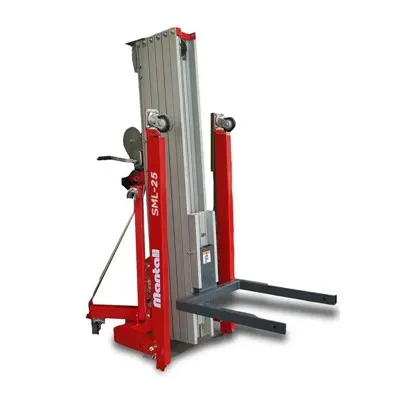
Let’s start with the baseline most people check first: the overall footprint, or the dimensions of the lift when it’s fully set up and ready to use. This isn’t just the length of the base; it’s the space the lift takes up on the ground, plus the amount of clearance it needs around its outriggers. For example, a standard 20-foot manual material lift we carry has a footprint when open of 4 feet wide by 6 feet long. That’s non-negotiable information for a customer working in a storage facility where each aisle is only 7 feet wide. If they just go by the base size when folded up (which is 2 feet wide by 5 feet long), they’ll get stuck trying to maneuver it into place once they unload it. We once had a customer in suburban Atlanta who skipped asking about the open footprint and ended up having to re-route a pallet of roofing materials around a storage rack because his aisle was only 6.5 feet wide—wasting two hours of labor and a whole day of roofing progress. Now, every time we quote a lift, we send a printable diagram that shows both folded and open footprint dimensions, plus a note on required clearance for outriggers, because even a 6-inch overhang can mean the difference between a smooth setup and a costly delay.
Next, the vertical dimensions are the second most critical set of specs, and they go far beyond the maximum reach. The key here is two numbers: the lift height (how high the platform or forks can extend) and the lowered height, which is how short the lift is when it’s not in use. A lot of first-time buyers only look at lift height, but lowered height is make-or-break for transport and storage. For example, a 30-foot electric material lift has a lowered height of 7 feet 2 inches, which means it can fit through most standard garage doors and on the back of a 16-foot flatbed truck. But a 40-foot model we carry has a lowered height of 8 feet 5 inches—too tall for most residential garages, so customers who are planning to move it between job sites often need to rent a box truck with a higher roof. We also run into customers working on second-floor remodels: a 25-foot lift can reach a second floor with a 10-foot ceiling if it’s parked just outside, but if the second floor has a low eave (say, a 9-foot eave line), that same 25-foot lift will only reach 15 feet from the ground when parked, leaving them 6 feet short of their target. That’s why we always ask for not just the desired lift height, but the exact ground clearance at the job site and the height of any structures nearby that could block the lift’s path.
Then there are the load-related dimensions, which are tied directly to how much you’re lifting and what shape the load is. This includes the platform size (or fork length and width) and the load capacity’s “footprint” on the platform. A common mistake customers make is buying a lift with a high weight rating but a too-small platform. For example, we have a 5,000-pound material lift with a 4-foot by 4-foot platform. It’s perfect for lifting pallets of drywall that are 48 inches by 48 inches, but if a customer needs to lift a 10-foot length of steel pipe, that square platform isn’t wide enough to support it without it sticking out the sides, which violates OSHA safety guidelines for load overhang. On the flip side, a lift with a 5-foot by 8-foot platform is too heavy to maneuver through tight warehouse aisles, even if its weight rating is the same. We had a masonry contractor in Dallas tell us last year that he’d rented a competitor’s lift for a job laying brick on a 18-foot wall. The lift had a 4,000-pound rating, but its platform was only 3 feet wide, so he had to stack only 500 pounds of brick at a time, making 12 extra trips up and down. We sold him a lift with a 4-foot wide platform and the same weight rating, and he cut his job time by three hours. It’s not just about the weight—its about the space you have to put that weight.
I also want to talk about the dimensions that don’t show up on spec sheets: the turning radius for mobile material lifts. This is something most manufacturers list vaguely, but we’ve refined our numbers based on real job sites. A push-around material lift might have a turning radius of 8 feet, but in practice, that means you need 8 feet of space to turn it around a tight corner in a warehouse. We once worked with a logistics company in Chicago that had a narrow back hallway between two storage zones; they were trying to use a larger lift that had a 10-foot turning radius and couldn’t make the turn at all. We recommended a compact model with a 7-foot turning radius that fit exactly, and they’ve re-ordered three more times since then for their other facilities. The spec sheet says “turning radius: 7 feet,” but that’s measured from the center of the lift’s front wheel, so we tell our customers to add an extra foot if they’re working on uneven ground or around obstacles like pallets or furniture, because those add a foot or more of space you need to maneuver.
Another dimension that’s often overlooked is the ground clearance of the lift’s chassis, which is how high the bottom of the lift is off the ground. This is critical for job sites that are uneven or have debris. A lift with 6 inches of ground clearance can handle a job site with small rocks or ruts, but a lift with only 3 inches of ground clearance will get stuck on a pallet of blocks or a small pothole. We recently had a customer working on a residential roof replacement in Houston; their job site had a few muddy spots from recent rain, and a competitor’s lift (with a 3-inch ground clearance) got stuck halfway through a lift and had to be towed, adding $500 to their rental cost. The lift we recommend for that type of work has 7 inches of ground clearance and solid rubber tires, so it can handle uneven terrain without getting stuck. That’s the kind of detail you don’t get from a generic spec sheet, but it’s the difference between a smooth job and a headache.
Over the years, we’ve also learned that customer needs change, so we offer adjustable dimensions on many of our models. For example, our telescoping material lifts have extendable platforms that can adjust from 3 feet to 5 feet wide, so customers can widen the platform for large loads and narrow it for tight spaces. We also offer adjustable outriggers that can extend from 2 feet to 8 feet wide, so you can set up the lift on uneven ground without having to level the entire job site. A lot of new customers assume that all material lifts are one-size-fits-all, but that couldn’t be further from the truth. We work with each customer to match the dimensions of the lift to their exact job site, not the other way around.
I want to emphasize that there’s no “best” dimension for a material lift—it all depends on what you’re lifting, where you’re lifting it, and how you need to move it. A contractor doing residential remodels in cities with narrow alleys will need a compact lift with a small footprint, while a warehouse manager lifting pallets of goods will need a larger lift with a wide platform and high capacity. The mistake we see most often is customers choosing a lift based only on weight rating, without checking the actual dimensions that matter for their specific job. We’ve made that mistake ourselves early on in our business—we sold a lift to a customer in Denver that had a perfect weight rating for their job, but its open footprint was too big for their loading dock, and they had to return it within 24 hours. That taught us that dimensions aren’t just numbers—they’re the foundation of a successful rental or purchase.
If you’re in the market for a material lift, skip the generic questions and ask for the specific dimensions that apply to your job. What’s the width of the narrowest aisle you’ll be working in? How much clearance do you have for the lift’s height? What’s the size and weight of the loads you’ll be lifting? What type of ground will you be working on? These are the questions that will help you pick the right lift, not just looking at a spec sheet that says “5,000-pound capacity.”

At the end of the day, our job as a material lift supplier isn’t just to sell you a piece of equipment—it’s to make sure that equipment fits your job. We’ve spent years collecting data from thousands of job sites, refining our dimensions, and adjusting our inventory to cover every possible need, because we know that a lift that doesn’t fit your space or your load isn’t worth renting or buying. If you’re planning a project and want to talk through the right dimensions for your material lift, feel free to reach out to us for a no-obligation consultation. We’ll walk you through every spec, share real customer stories, and help you pick the lift that will make your job go as smoothly as possible.
Telescopic Boom Lift References
- Occupational Safety and Health Administration (OSHA). Material Handling Equipment Safety Standards, 29 CFR 1910.178, 2023.
- Power Access Equipment Association (PAEA). Material Lift Dimensions & Specification Best Practices, 2022.
- Construction Equipment Association (CEA). Compact Lift Performance in Tight Work Environments, 2021.
- National Institute for Occupational Safety and Health (NIOSH). Load Capacity and Platform Size Guidelines for Material Handling Lifts, 2020.
Mantall Heavy Industry Co., Ltd.
Mantall Heavy Industry Co., Ltd. is well-known as one of the leading material lift manufacturers and suppliers in China, featured by quality products and good service. Welcome to buy discount material lift made in China here from our factory. For pricelist and quotation, contact us now.
Address: NO.62, Binhai Avenue, Binhai Industrial Park, Qidong City, Jiangsu Province, China
E-mail: Gloria@mantall.com
WebSite: https://www.mantallawp.com/
